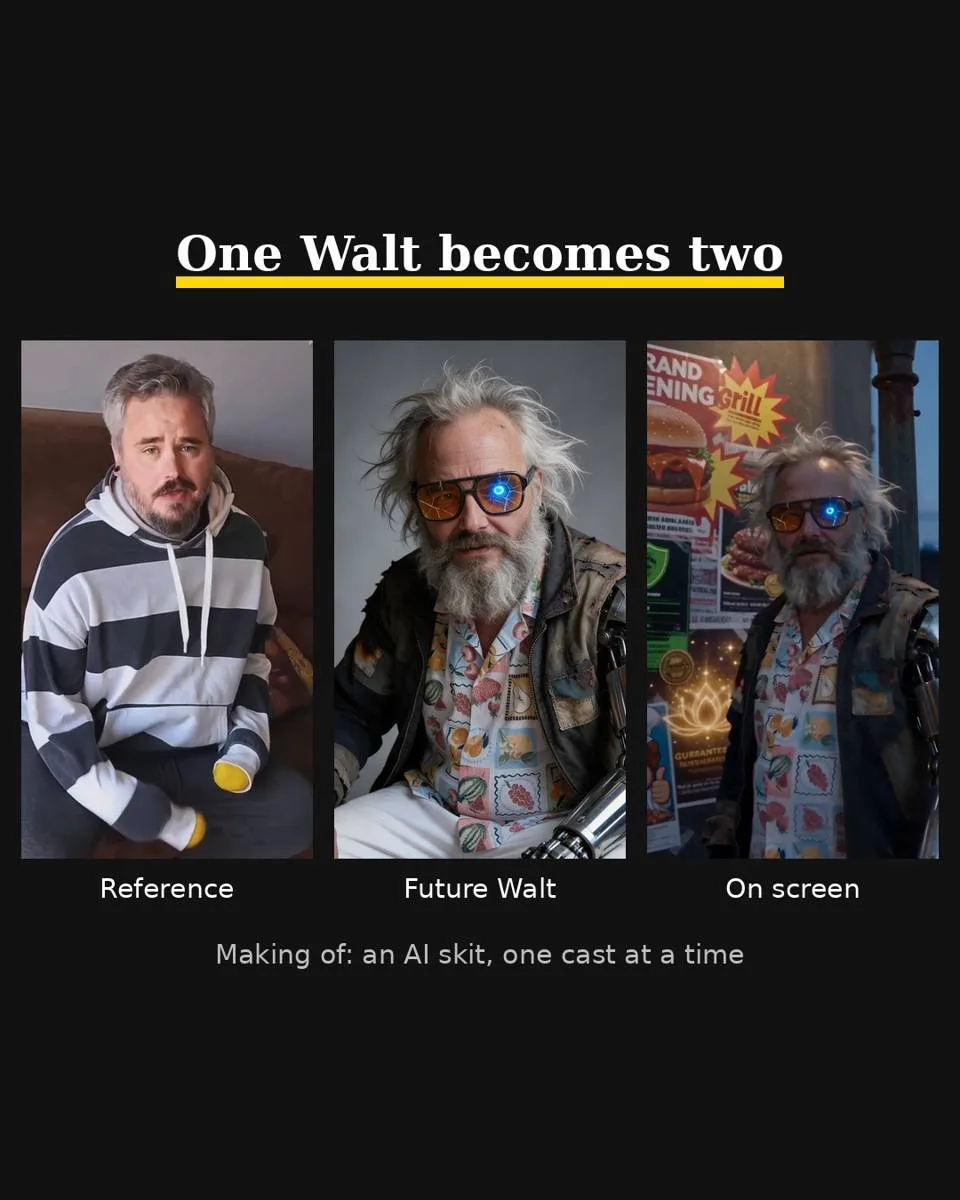
I made a skit called Back in Time (Backrooms Part III), starring three versions of me. Young Walt is the me you know: a floral shirt and orange shades. Future Walt is the same man, older, with a cyber arm and a cyber eye. The third is a father in a striped jacket with lemons for hands, borrowed from a Lemonhands™ ad. At one point Future Walt asks, "What year is it?" and Young Walt answers, "Must be 2026."
All three Walts, the music and the sound effects were made with AI, and so was the first version of the voices. For the final cut I recorded the voices myself. I put the pieces together, so this post is the whole story in one place: how it was made, what it cost, what went wrong, and where this kind of thing is useful for other people.
The skit is, naturally, sponsored by Lemonhands™. More on that below.
You can watch the skit on Instagram and Facebook.
Where the lemons come from
Lemonhands™ is a citrus-based hand replacement system for people who have been given lemons by life and would like to make it official. It is powered by LifeCoach Technologies®, it has a clinical handbook with four figures, and its results are, in the site's own words, not typical. It is also entirely made up, and one of my favourite things to have built.
The father in the ad, the one in the striped jacket with the lemons, is AI Walt too, and he is a very satisfied Lemonhands patient. If you want to see where the idea started, the site also announces Lemonfeet™ for 2027. We have been asked to stop. We have not stopped.
How it was made
The pictures came from a handful of video models: Seedance 2.5 (the Pro version for finals, the cheaper Flash version for drafts), Wan 3.0 and Kling Omni3. The voices came from ElevenLabs, using a voice set up to sound like mine. The music was a 30-second piece from Google Lyria, and the sound effects were generated one at a time. I joined and mixed it all on my own computer, ducking the music under the speech.
The opening title and the short music sting were built to match this site: black, a yellow underline, a thin teal circuit line. Two end cards close the skit, one for Lemonhands and one for this site.
To record my own voice I needed the AI speech out of the soundtrack. An open-source tool called Spleeter split the finished mix into the voices and everything else, so the music and sound effects stayed and I could lay my own lines over them. Separating a finished mix is never perfect, so it pays to listen for traces of the old voices.
What it cost
I spent about 15,500 credits from a 20,000-credit Premium plan. That figure is for the whole account, so it may include some earlier experiments.
The pictures are where the money goes. The top model cost 1,760 credits for a four-second shot, and the cheaper one 1,160. Lip sync was 1,200 credits a clip on the better pass and 420 on the cheaper one. Everything to do with sound was almost free by comparison: a voice line cost 10 to 12 credits, the music 80, and a sound effect 5 to 15.
So I drafted on the cheaper model, tried the expensive one on the same shots, and used the cheaper lip sync pass to make the budget fit.
I put the numbers, the model comparison and the fixes into a short deck: download the making-of deck (PDF).
What went wrong
One Walt had to become three. Young Walt and Future Walt are the same person at different ages, and the father is built on the same face, so the models want to blend them all. Giving each one its own reference image kept them apart.
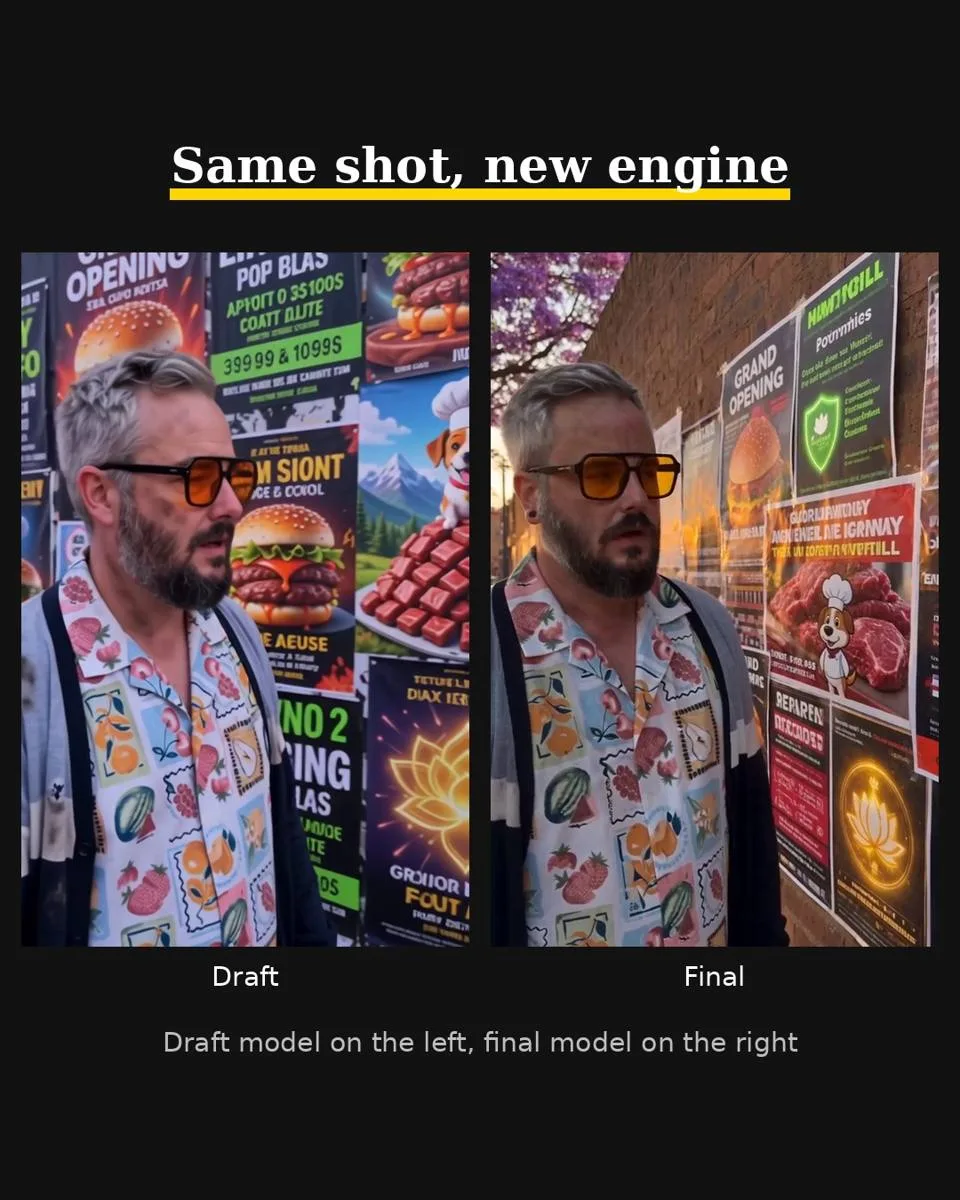
The expensive model was not always the better one. The same shot, drafted on the cheaper model and re-run on the pricier one, looks like a different film. The pricier version is cleaner and more polished, but I preferred the grittier draft on the left, and that is the one in my final cut.
The old footage had subtitles burned in. AI caption removal took the words off, but it changed the face too. I tried cropping next, and in the end I found a clean copy of the clip.
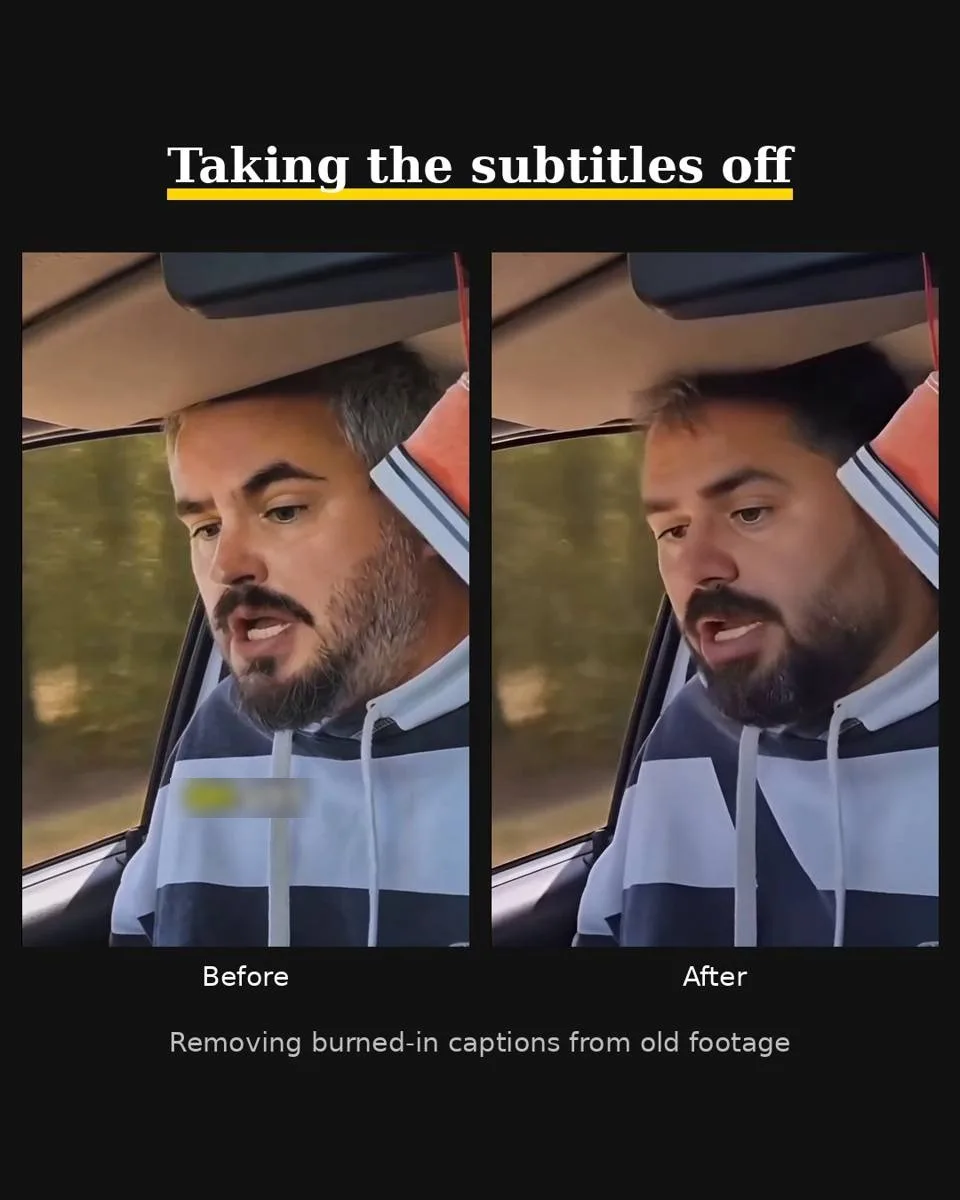
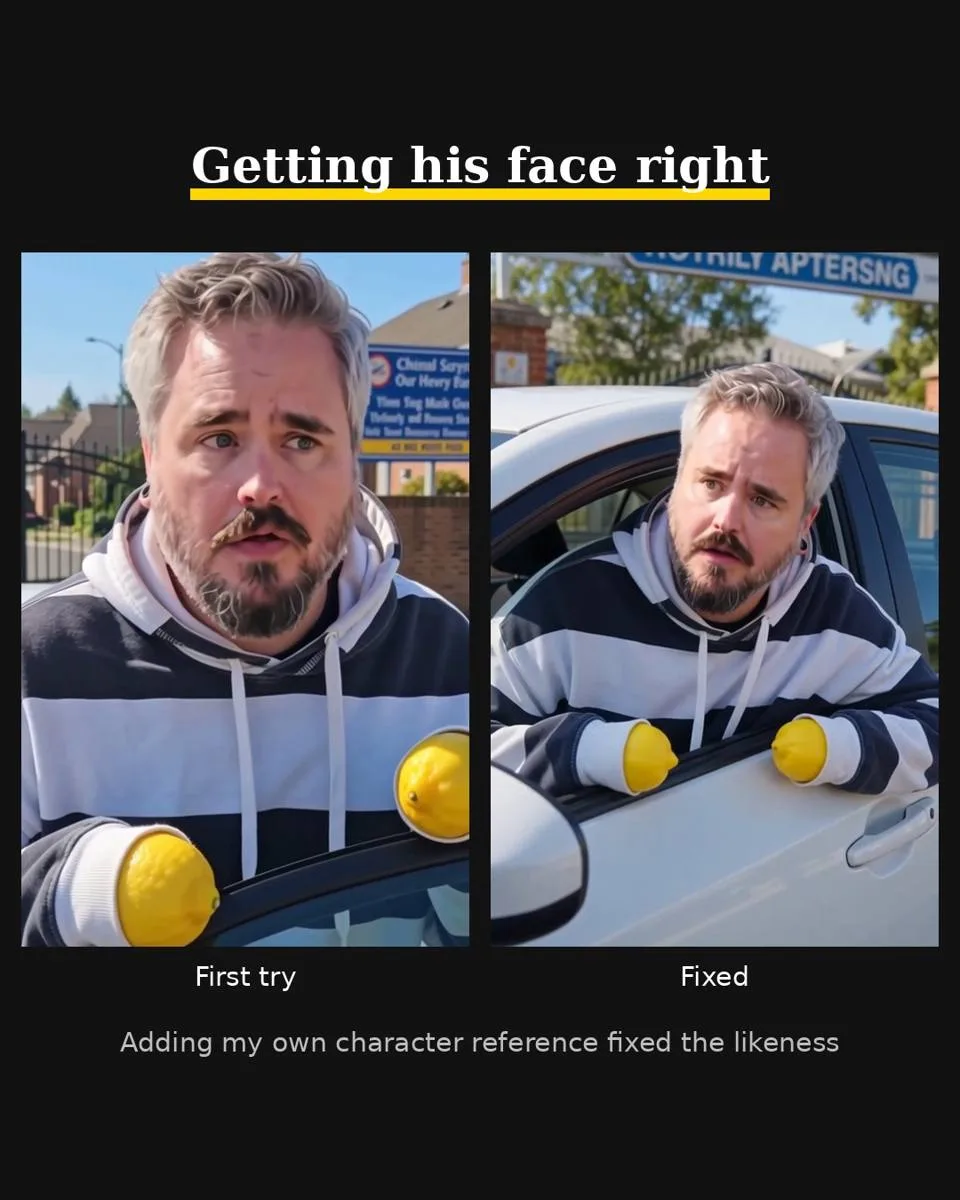
The face drifted. The driving shot is built on my face, and after the caption removal the man in it no longer looked like me. Connecting my own character reference to those shots fixed it, at the price of a few extra re-rolls.
Where virtual real people are useful
A believable version of a real person, made with their permission, can do useful work. These are the places I can see it helping a small business:
- Training and onboarding. A face and voice people already trust, without a filming day every time something changes.
- Product explainers. You update the script instead of re-filming.
- Consistent content. A founder who cannot be on camera every week still has a face for the brand.
The rules I would set are simple. Use only your own likeness, or someone's written permission. Say clearly that it is AI. And keep a human in charge of writing the script and judging the result, because the models will happily give you something that looks right and says the wrong thing.
I also made a 30-second video of these three uses, with the rules at the end, for my business Facebook page.
The website
The skit's last joke is about this site. The new waltviviers.com is built around how I actually work: creative direction, workflows and tools, and making the work myself. Design, fine art, photography and video, apps and games, and this journal all sit in one place. There is a media kit if you want the short version, and Lemonhands lives on its own address, as a reminder that the work does not always have to be serious.
A skit about three Walts is a good way to say what the site says: one person, a lot of tools, and a point of view.
Was it worth it?
For a one-person studio, yes. Would I do it blind? No. The skill is in the planning: knowing which shots deserve the expensive model, and catching the likeness before it drifts. The dearer model is not always the better one, either: in my final cut I kept a cheaper draft.
If you want to explore whether a virtual version of you, or your people, could work for your business, that is part of what I do as a creative consultant.
The same story is running across my channels today: the skit on Instagram and Facebook, the cost breakdown on LinkedIn as a swipeable deck, a short video on what a virtual character can do on my business Facebook page, and a question on Threads that I would love you to answer: if you could tell the you of ten years ago one thing, what would it be? And what would you leave out?